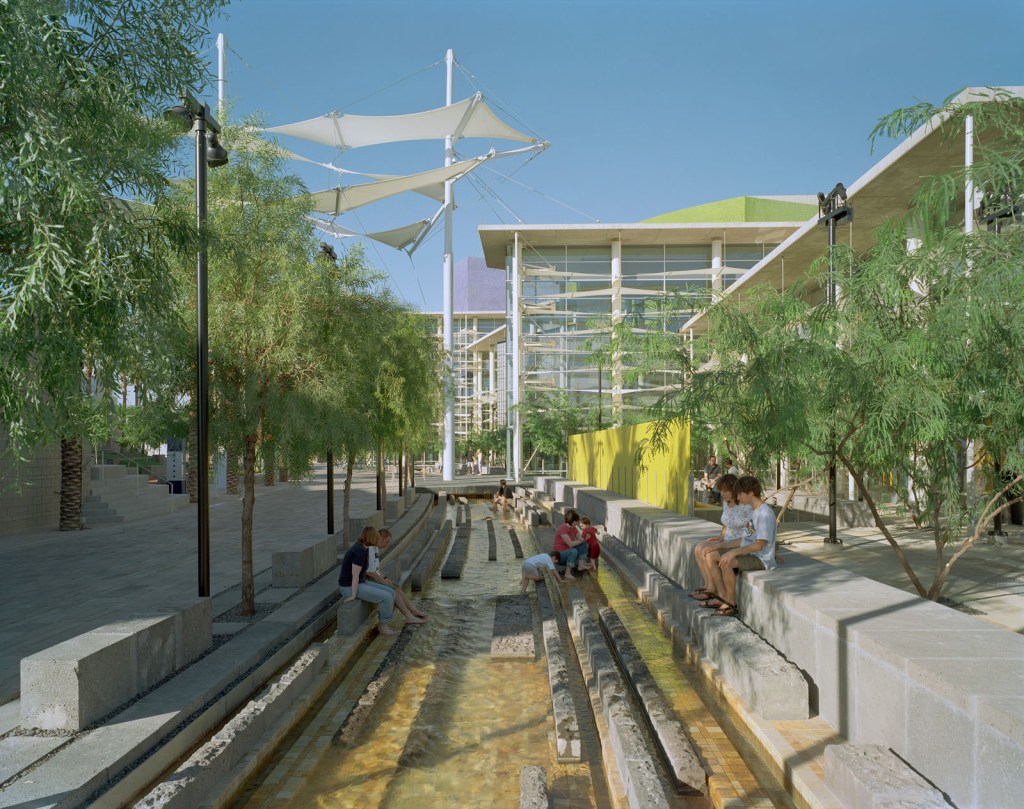
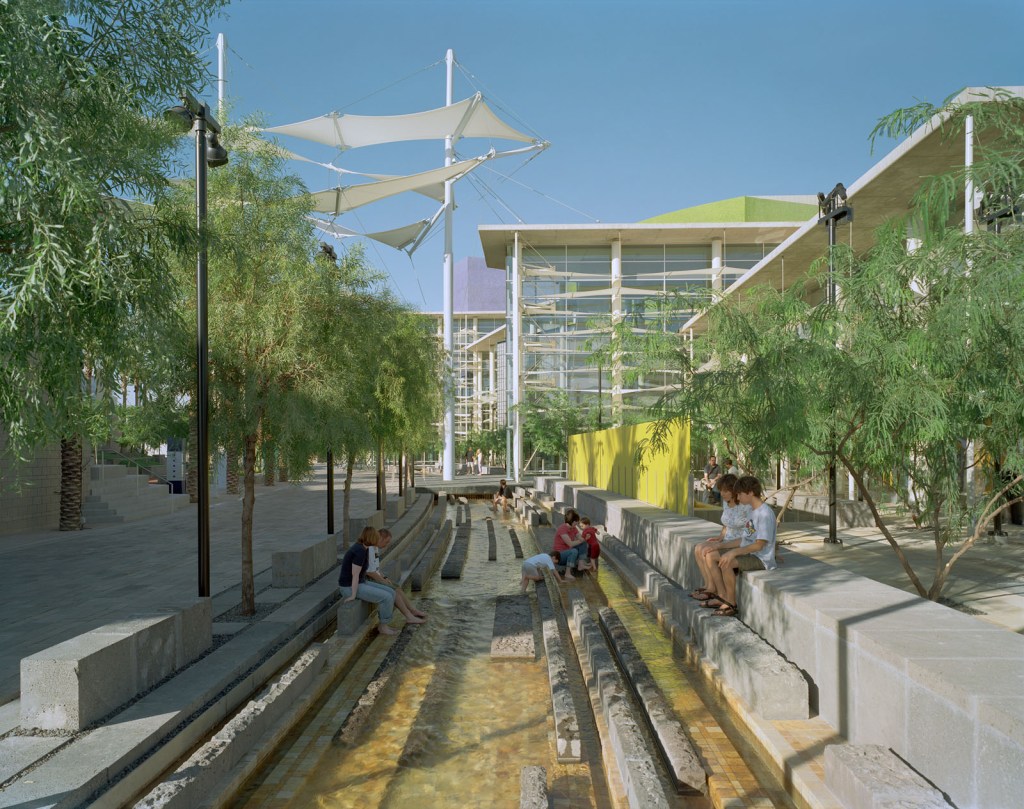
Desert cities face immense challenges. Especially when it comes to sustainability, or mitigating climate change. They face water shortages, and intense heat waves further exacerbated by urban heat islands.
Practically living h*ll if you ask me.
Urban heat islands are when cities’ temperatures are much warmer than its surrounding areas.
Which is precisely why desert cities must be front runners in transitioning to sustainable cities. I mean, they have no choice, really.
Take Mesa, Arizona, for instance. This desert city is the 3rd largest in the state, with over half a million people.
Naturally, this places immense pressure on water supplies.
Which is why they have adopted LID, or low impact development as a way to manage stormwater runoff along with other benefits.
The principles of LID:
- Keeping water close to the source
- Preserve landscape features
- Minimize imperviousness
- Create functional, appealing site drainage
- Treat stormwater as a resource, not waste
- Reduce impact of built areas
- Promote natural movement of water
- Protect ecologic + hydraulic functionality
- Encourage sustainable stormwater practices
Some features of LID include implementing curb cuts, vegetated swales, and permeable paving.
Yeah. That was a lot of vocabulary.
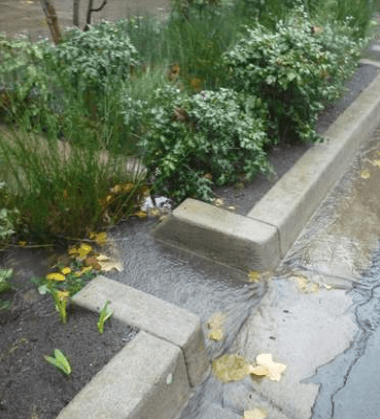
In case you don’t know, curb cuts are spaces created in curbs. You may or may not have seen them before, since they seem kinda negligible.
Standard Curb Cut
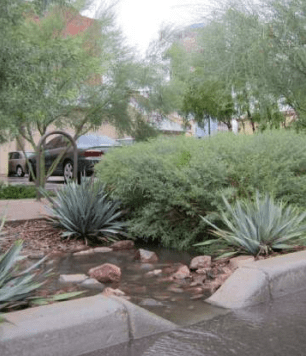
Essentially, the space allows stormwater to flow from roads or parking lots to infiltration areas—-rather than flowing directly to storm drains and waterways that creates risks for potential flooding.
There are different styles. Like this one.
Curb cut with side-wings
If you are curious about your town’s green infrastructure, next time, check parking lots, pedestrian paths, or parks. They are often installed in these places.
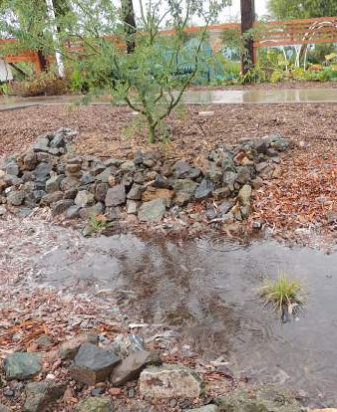
Vegetated swales or bioswales are one of the infiltration areas. They are shallow channels that typically contain deep-rooted native plants.
Just to point out, stormwater carries a lot of gunk. Sediments, fertilizers, waste, anything on the ground, you name it.
Not only do they spruce up spaces and act as small islands of habitat, these vegetated swales are also functional. The plants’ roots actually filter out the pollution and help infiltrate water into the soil.
Vegetated Swale
Of course, there are challenges to the LID approach.
Like dealing with risky new technologies. Or persuading residents to opt for native vegetation over grass lawns—as much as they look nice.
Anyways. It’s not foolproof. Nor is it the definite solution to solving Mesa and other desert cities’ issues.
But it’s definitely an approach every city and community should consider and implement.
Sources:
Gilles, Haley, and Van Patterson. “Case Study: Low Impact Development In Mesa, Arizona.” Arizona State University, https://static.sustainability.asu.edu/giosMS-uploads/sites/22/2015/01/Mesa-LID-Report.pdf. Accessed 25 May 2022.
Logan Simpson, et al. “LOW IMPACT DEVELOPMENT TOOLKIT.” City of Mesa, 2015, https://www.mesaaz.gov/home/showpublisheddocument/14999/635784263545170000. Accessed 25 May 2022.
 The City Planter
Leave a comment