
Being a driver, it’s safe to say you probably ran over or nearly ran over an animal once or twice. Your tires get stained with blood, perhaps there’s a dent on your bumper—but that’s not what we’re REALLY concerned about, right?
It’s the 350 MILLION animals that are killed per year from these car collisions, and if we were counting insects—trillions.
As we continue to build more roads, houses, and other land developments, we are also displacing and fragmenting animals’ habitats.
But there’s a way to mitigate habitat fragmentation: wildlife corridors. Building wildlife their own roads across our roads, or whatever existing human infrastructure. After all, it’s not very nice to kick someone out of their home so we have to show this amount of courtesy.
The corridors help link islands of habitats together so animals can cross the road safely. It’s also much easier for the animals to move around and find resources.
Here’s what one of them looks like.
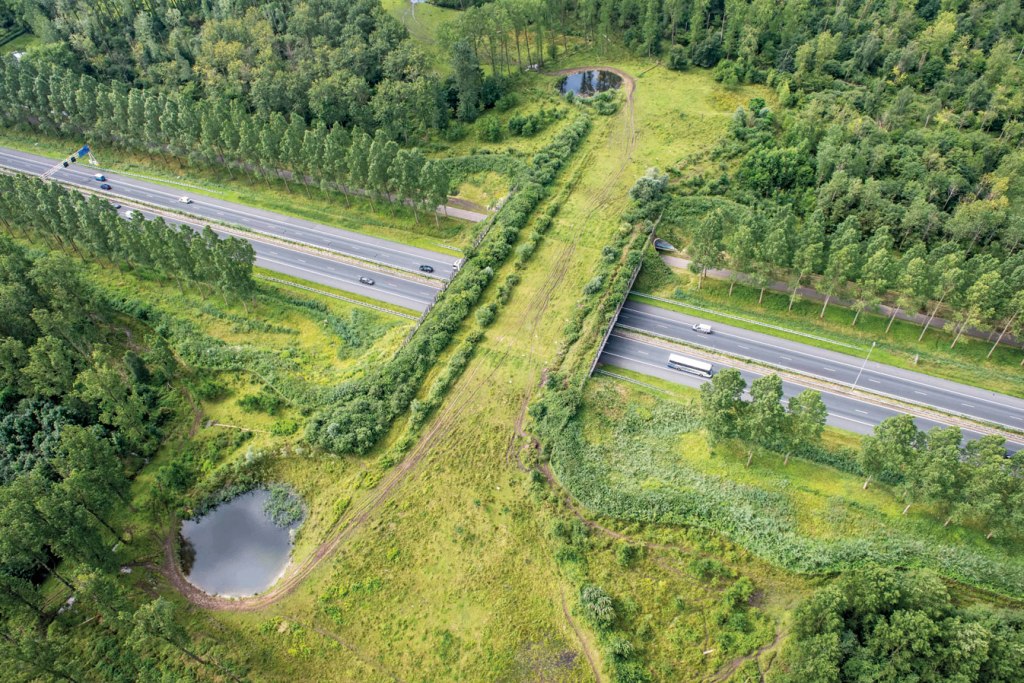
Cool isn’t it? They spruce up the area too— let’s be honest, highways are pretty drab. The vegetation also reduces air pollution and mitigate climate change by taking in emissions from the cars.
Wildlife corridors can range from all shapes and sizes. Let’s take a closer look at this one.

This corridor is one of the first in Southeast Asia, and it connects two major forests: the Bukit Timah Nature Reserve and the Central Catchment Nature Reserve. The forest is split by an expressway that was built to ease traffic congestion and serve as a shortcut to the city center.
Dividing the forest probably wasn’t the best for the ecosystem as it isolated populations from each other and limited interaction between wildlife on different sides.
To address this issue, the idea of a wildlife overpass was drafted during the Singapore Green Plan. The focus of the project was to support animals with limited range, species vulnerable to roadkill, and threatened species. Other animals like forest birds, bats, and invertebrates would also benefit from this.
In the process of constructing the hour-glass shaped bridge, over 3,000 native plants were used to green the wildlife corridor. Soon enough, camera trappings showed animals like pangolins and palm civets crossing the bridge.
If this isn’t called success, I don’t know what is. Though we can’t “undo” the roads and the houses we built, we can definitely build roads and houses for animals too.
Sources:
Eco Link At Bukit Timah Expressway. SG101, 2021. SG101, https://www.sg101.gov.sg/resources/connexionsg/ecolink.
Fei, Chung Yi, et al. “Eco-Link@BKE: A Safe Corridor for our Biodiversity.” National Parks Board, https://www.nparks.gov.sg/-/media/cuge/ebook/citygreen/cg12/cg12_eco_link_at_bke.ashx?la=en&hash=DB96CEE8B415BCE336D79ADDCB535F836FC35708. Accessed 4 December 2022.
Fox, Natalie. “Wildlife Corridors.” Mossy Earth, https://mossy.earth/rewilding-knowledge/wildlife-corridors. Accessed 4 December 2022.
Schilthuizen, Menno. “Roadkill Literally ‘Drives’ Some Species to Extinction.” Scientific American: Science News, Expert Analysis, Health Research – Scientific American, 2022, https://www.scientificamerican.com. Accessed 4 December 2022.
“What are wildlife corridors? – DCCEEW.” Department of Climate Change, Energy, the Environment and Water, 12 October 2021, https://www.dcceew.gov.au/environment/biodiversity/conservation/wildlife-corridors. Accessed 4 December 2022.
 The City Planter
Leave a comment